BA, BF and FG Falcon Manual Conversion: T5 vs TR6060, and What a Real Kit Costs
10 min read
Short version: Ford did put a five-speed behind the turbo six, so a genuine 2002 to 2004 BA XR6 Turbo manual is a factory car and not a bogus listing, but the T5Z it used was marginal when the car was new and putting one behind a Barra you have since turned up is a countdown, not a build. If the engine is a turbo six and you are building it, you want a Tremec, either the T56 out of a BA Series II to BF donor or the TR6060 out of an FG, and you want the turbo-specific bellhousing and flywheel that go with it, because turbo and non-turbo Barras do not share them. There is no Getrag gearbox anywhere in the Falcon manual lineage despite what half the used listings say. A DIY conversion on used parts realistically starts around $3,000 for a T5 build and lands somewhere between $4,000 and $7,000 in parts for a Tremec build, with shop-fitted six-speed conversions running well past $10,000 once labour and a retune are in. Here is the whole parts list and where the money actually goes.
Which gearbox came in which Falcon
Get this straight before you buy anything, because sellers use these names loosely and the wrong box is an expensive mistake.
- BA and BF XR6, non-turbo: a five-speed T5. This is the six-cylinder end of the T5 family, which traces back to Ford's base four-cylinder Mustang gearbox rather than the strong 5.0 litre one, so it is not the gearbox American V8 owners talk about. Falcon rebuilders draw a further line between the plain six-cylinder boxes and the better gear sets that went into the V8 and turbo units, which is why "it is a T5" tells you almost nothing on its own.
- BA XR6 Turbo, from the September 2002 launch to the October 2004 Series II update: also a five-speed, the uprated T5Z. Ford Australia genuinely sold this car, so a correctly advertised 2003 XR6 Turbo five-speed is a factory manual, not a conversion and not a scam. It is the strongest T5 Ford put in a Falcon and it was still widely judged the car's weak point when new.
- BA GT and Pursuit, Boss 290 V8: a five-speed Tremec TR3650. Different unit again.
- BA Series II through BF, XR6 Turbo, XR8 and the FPV models: the six-speed Tremec T56, which replaced the T5Z behind the turbo six at the October 2004 update.
- FG and FG X, XR6 Turbo and GT: the six-speed Tremec TR6060, the T56's successor, carried to the end of Falcon production.
The practical takeaway is that "manual Falcon" describes at least five different gearboxes, two of which answer to the name T5. Get the exact model and build month of the donor car before you agree to anything, not just "BA XR6T manual". None of it applies if you are putting a Barra in something that never had one, where the gearbox is whatever you choose to bolt to it.
The Getrag myth
You will find used listings calling a Falcon five-speed a Getrag. Ignore them. Getrag never supplied a manual gearbox to the Falcon range: every factory manual in a BA, BF or FG is a BorgWarner or Tremec design, whether badged T5, T5Z, TR3650, T56 or TR6060. The claim appears in one mainstream buyer's guide describing the BA Series II box as "Getrag-sourced" and in the occasional wrecker listing, and it contradicts every technical source and the well-documented origin of the T56 itself. Getrag's real Australian relevance is Holden and HSV V8s, not Fords. The Territory never got a manual at all, so there is no back door there either. If a listing says Getrag, ask for a photo of the casting tag before you send money, because the same seller has probably muddled the speed count too.
The T5 question, answered honestly
This is the search everybody runs and the answer is not what people want to hear.
The six-cylinder Australian T5 is commonly cited as rated to around 350Nm. The turbo car's T5Z was uprated over that, on better gear heat treatment and a stronger input shaft, but Falcon rebuilders quote its ceiling in rear-wheel kilowatts rather than a published torque figure, so treat any hard Nm number you see for the turbo box with suspicion. A stock naturally aspirated Barra already makes roughly 380 to 390Nm. A factory turbo Barra makes somewhere between 450 and 565Nm depending on variant. Owner experience lines up with the arithmetic: the T5 holds together fine to around 200 to 220kW, and failures start showing up in the 270 to 300kW range, with the occasional outlier surviving more for a while. Turbo torque kills them noticeably faster than supercharged or naturally aspirated power at the same peak figure, because the load is sustained rather than peaky.
So: the T5 is a reasonable box behind a stock or mildly worked non-turbo Barra, and it is the cheapest way to get three pedals in a BA. Behind boost it is a factory compromise that Ford itself dropped at the first major update, which tells you what the factory thought of it. If you already own a genuine XR6 Turbo five-speed and the engine is standard, it is a real car and worth leaving alone. It is not the box to build a boosted engine around, and it is a particularly poor choice for a drift car, where clutch kicks and shock loading are the entire point. Used and reconditioned Australian units typically run around $1,250 to $2,000.
One trap with T5s specifically: Ford Australia used several physically different T5 variants across the XF to BA range, differing in length, shifter position and spline count, and the turbo T5Z is another variant on top of those. They are not interchangeable in a casual way, so the gearbox, bellhousing and tailshaft need to come from one matched donor generation rather than three bargains from three sellers.
The Tremec step up
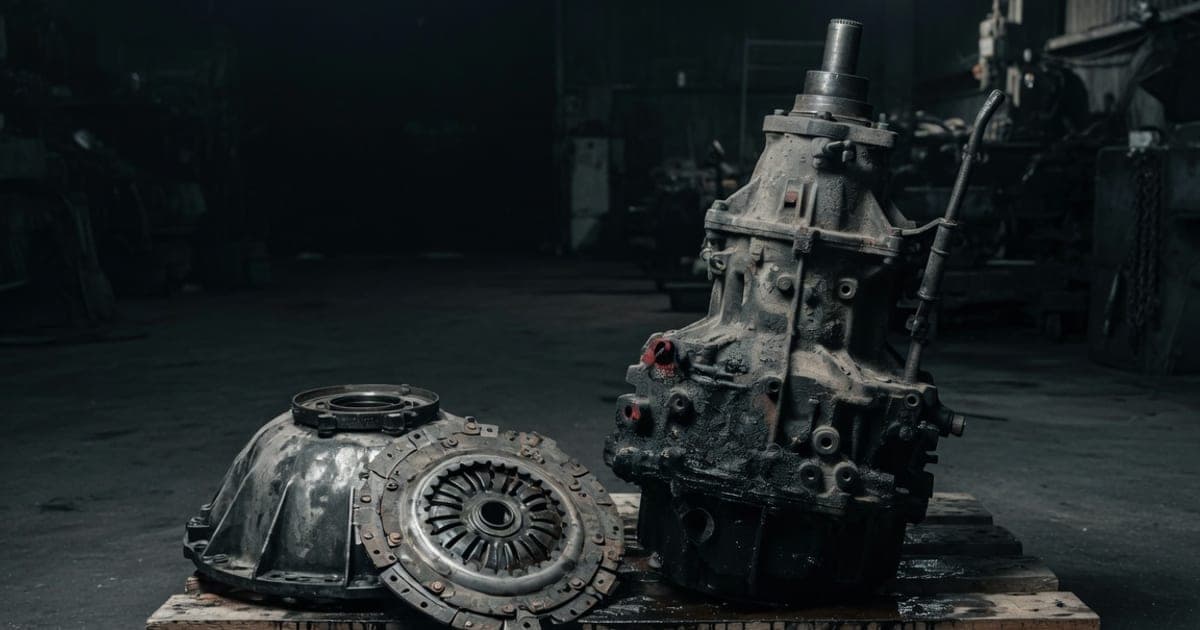
The T56 and the TR6060 are the real answer for a turbo Barra, and the ratings show why. Falcon transmission specialists quote the naturally aspirated TR6060 at around 390Nm and the turbo TR6060 at around 520Nm. Note that carefully: the same casing houses different internals depending on which car it came out of, and the turbo version also runs a heavier flywheel and clutch. Buying a "TR6060" tells you less than you think. Buy the one that lived behind a turbo.
Sourcing runs three ways. Most conversions use a factory take-out from a wrecked manual FG or BF, and these turn up in classifieds as complete kits with the gearbox, clutch, crossmember, tailshaft and pedal box together, which is exactly how you want to buy them. Second, VE and VF Commodore TR6060 units are plentiful and typically run $3,300 to $6,000 used, but they need a purpose-made bellhousing to meet a Barra, and Dellow Conversions builds one for that combination. Third, new units exist at close to $10,000, which almost nobody does. A TR6060 rebuild kit sits around $970 to $1,080 if you find a tired box cheap.
The bellhousing difference nobody mentions
This is the single most important fitment fact in the whole job, and it is the one most commonly stated backwards.
Turbo and non-turbo Barras do not share a flywheel and bellhousing setup. The clearest documented split is on the FG: the non-turbo runs a 340mm flywheel and ring gear outside diameter, the XR6 Turbo runs 355mm, and the turbo also needs its own backplate and starter to suit. This is not a theoretical difference. Dellow makes you choose between the FG Turbo 355mm pattern and the BA standard 340mm pattern when you order a bellhousing, and clutch makers like NPC Performance sell their kits as separate product lines per exact engine and gearbox combination rather than one universal Barra kit.
What that means in practice: match the clutch, flywheel, bellhousing and gearbox to your specific engine variant, and buy them as a matched set from one donor or as a kit sold for your exact combination. The classic cheap-conversion failure is a good gearbox from one car, a bellhousing from another and a flywheel from a third, discovered on the hoist at midnight.
What a complete conversion actually needs
The gearbox is maybe a third of the job. The full list:
Crossmember. The auto and manual crossmembers are different parts. Take the correct one from the same donor generation.
Pedal box and clutch master. An auto Falcon has no clutch pedal provision at all, so you need the complete manual pedal box assembly. Used FG pedal boxes run around $450 and suit the T5, T56 and TR6060 alike. Budget an afternoon, because it is a firewall job.
Clutch and flywheel. Matched to the gearbox and, critically, to the turbo or non-turbo pattern above. Buy this new.
Tailshaft. Different length and yoke to the auto shaft. Usually custom made or modified, commonly around $400. Do not assume the auto shaft bolts up.
Wiring and the PCM. The manual loom has a different plug pattern to the auto one, and you need the reverse light circuit, the clutch and neutral switch wiring, and on FG cars the reverse lockout solenoid. The engine computer then needs a retune to run as a manual without throwing faults, which is a paid service either way: dedicated Falcon PCM reflash services advertise around $395, and Adelaide's Athol Park Wreckers offers the whole conversion as a supply-and-fit package with factory Ford diagnostic programming.
Shifter, boot and console. Comes across with the gearbox and tunnel trim from the donor.
Speedo, usually not an issue. On these cars the speed signal comes from the ABS module rather than the gearbox, so the cluster generally carries on regardless. Non-standard combinations are the exception.
Real Australian suppliers worth knowing: Mal Wood Automotive for reconditioned boxes and short-throw shifters, Dellow Conversions for custom bellhousings (allow four to six weeks), NPC Performance for matched clutch and flywheel kits, and Falcon-specialist wreckers for complete take-out packages, including at least one Adelaide yard that does the whole conversion in house. Most conversions are ultimately fed by private sellers parting out a genuine manual donor, and the yard that knows the car is the one that tells you what you are actually getting.
What it costs
No shop publishes a single package price, so here is the shape built from real line items.
T5 conversion, DIY on used parts. Gearbox, bellhousing and pedal box together around $650, flywheel around $90, clutch around $250, plus the usual few hundred in miscellaneous parts. Call it roughly $1,250 in parts if you shop well, then around thirty hours of labour. Paying a workshop for that puts the job somewhere around $3,000 to $6,000 all in.
T56 or TR6060 conversion. A used donor box with its accessories typically runs $1,500 to $2,000, a turbo-rated clutch and flywheel around $500, tailshaft around $400, pedal box around $450, plus crossmember, wiring and the retune. Parts realistically land between $4,000 and $7,000 when the donor is a wrecked factory manual car, and owners report complete drivetrain packages from wreckers around the $6,000 mark. Build it around a new gearbox with a shop doing the work and $10,000 to $15,000 is realistic.
Both of those are derived from real component pricing rather than quoted totals, so treat them as the shape of the spend rather than a quote. The wider question of where a gearbox sits against everything else on a build is covered tier by tier in what a drift build really costs in Australia.
Worth pausing on before you commit: a factory manual XR6 Turbo often costs less to buy than an auto plus a proper six-speed conversion. If you are still choosing a platform rather than committed to the Falcon in your driveway, price both paths. The platform comparison is in best first drift cars in Australia.
Buy used, buy new
Buy used: the gearbox, the crossmember, the pedal box and clutch master, the shifter, the loom, and the tailshaft if it suits (though these often need re-machining rather than bolting straight in). These are durable parts off a car that still exists in huge numbers, and paying new money for them is money wasted. Inspect any used box for notchy or grinding second and third gear, the classic tired-synchro tell, and ask whether it lived behind boost.
Buy new: the clutch and flywheel, absolutely, and especially on a turbo car where owners are blunt that a reused standard clutch is simply not enough. Also the bellhousing and crossmember when your engine and gearbox combination does not match a factory donor, plus mounts, bushes and seals you disturb on the way through. The PCM retune is a service, not a part, and there is no secondhand version of it.
Buying a gearbox sight unseen from a stranger interstate carries the same risks as buying an engine that way, and the same defences apply: dated photos, a video call, and a price that reflects what you were actually able to verify. The full routine is in buying used parts without getting scammed.
Find the parts
Have a look at what is listed right now for gearboxes, bellhousings, tailshafts and clutch kits, and for the PCMs and looms that come off parted-out donors, because those are the parts people forget to buy until the car is on stands. Finished your own conversion and got the auto box, the auto crossmember and a pile of leftover brackets in the corner of the shed? List it free, because the next person doing this exact swap is hunting precisely that box of parts.