R180 vs R200 vs R230 Diff Interchange: What Actually Fits an S13, S14, S15 or Skyline
10 min read
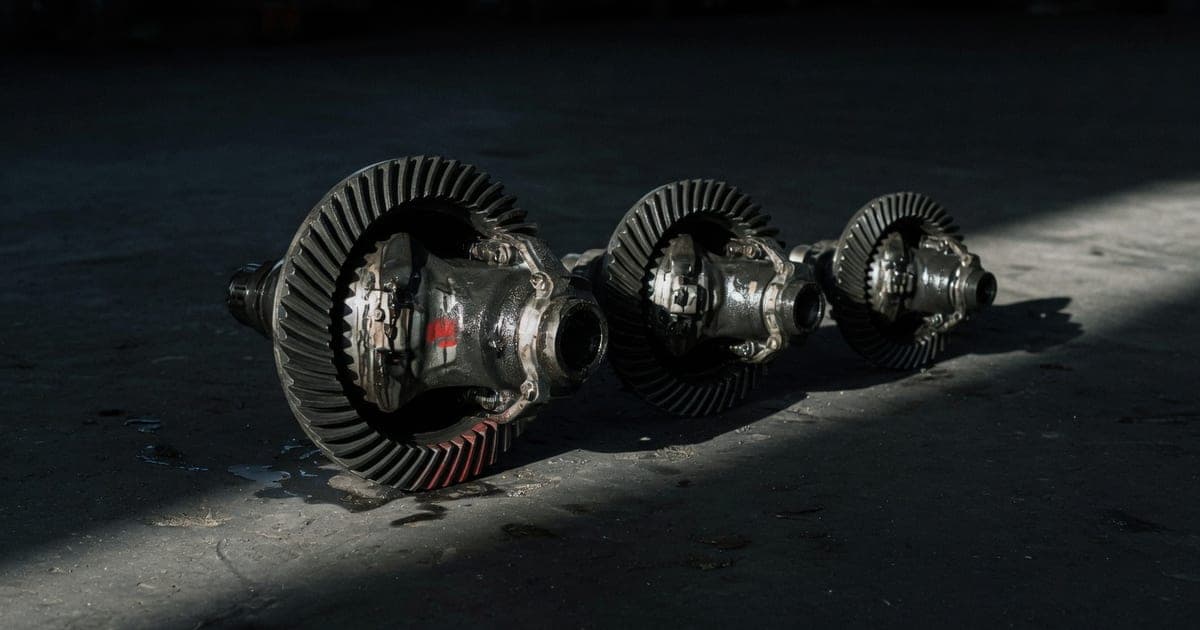
Short answer: R180 and R200 are Nissan diff families named after their ring gear size in millimetres, and every S13, S14, S15 and non-GTR Skyline runs some version of one or the other, though a surprising number of early, non-turbo S-chassis left the factory on the smaller R180, so check rather than assume. The real trap is that two diffs can both be genuine R200s and still not be a swap, because it is the output flange and spline count, not the family name, that decides whether a diff's axles will actually mate up to your car. R230 is real too: a bigger, stronger diff out of the Z32 Twin Turbo, and a genuine but frequently mislabelled upgrade path for serious power. Below is the actual interchange map, how ratio choice works, what the Ford or Commodore diff question really involves, and how to identify what is already sitting under your car.
The three diff families, and what actually shares each one
Nissan's rear diff codes are not model names, they are roughly the ring gear diameter in millimetres, and the number tells you the diff's strength family before you ever open the cover.
R180 is the lighter unit. It shows up in early and non-turbo applications across Nissan's RWD range, and the detail that catches people out: some non-turbo, JDM-spec S13 and S14 left the factory on an R180, not the R200 everyone assumes. If your car is a non-turbo Silvia or an unknown-history S-chassis, check before you plan an upgrade around R200 parts.
R200 is the volume diff, and the one most S-chassis and Skyline owners are actually dealing with: turbo S13 and S14, S15, the non-GTR Skylines (R32 through R34 GTS-T/GT-T), every GT-R rear, the Z31 and naturally aspirated Z32 300ZX, the 350Z, and some Q45 and Cedric/Gloria applications. "R200" covers a lot of ground, which is exactly why the next section matters: R200 is a family, not one interchangeable part.
The 350Z is a useful warning about that. It is genuinely an R200, but a Z33-specific case with its own crown gear height that does not interchange with S-chassis R200s, so "it is an R200 too" is not a fitment argument. Worth knowing when shopping one: base 350Zs came open, while Enthusiast, Touring and Track trims got the viscous unit.
R230 is the one people are least sure about, and for good reason. It turns up in the Z32 300ZX Twin Turbo (badged R230V) and in Q45-adjacent applications, and it is a real, documented swap-in for high-power SR, RB and LS builds that have outgrown an R200.
Two widely repeated claims are wrong. First, the R34 GT-R does not run an R230: every GT-R, R32 through R34, uses an R200 rear, which Nismo's own LSD part numbering confirms. One popular ratio chart says otherwise and disagrees with every parts catalogue. Second, sources conflict on R230 spline count, reporting 30 or 31, and the common "33" looks like the 33mm shaft diameter of a GT-R stub misread as splines. Count them on the part before buying axles, and treat the "Q45 diff" nickname as shorthand, since later Q45s ran an R200.
Why two R200s do not automatically bolt together
This is the real answer to "R200 diff interchange": the family name tells you ring gear size, not what will physically mate to your axles. That is decided by the output flange, its bolt pattern, and the spline count on the stub. Three distinct R200 flange types exist across the cars this site's readers own:
| R200 type | Flange | Found in |
|---|---|---|
| Tri-Y 6-bolt | Paired 6-bolt | S13, S14, S15 |
| 5-bolt | Even 5-bolt | Z32 NA, R32/R33 GTS-T |
| Big-spline 6-bolt | Even 6-bolt | Z32 Turbo, GT-R, Z33 |
Note what is not in that middle row. The S15 is a six-bolt car, same as the S13 and S14, despite a widely copied chart listing it as five-bolt. Sellers repeat that error constantly. The genuine S14 to S15 incompatibility is not the bolt pattern at all: it is that the input flange length differs by roughly 6mm, along with side flange lengths.
Spline counts vary within these groups by year and application and published figures disagree, so count them on the part rather than trusting a table, this one included. R180 runs its own lighter flange, smaller than any R200, so R180 and R200 axles never mix.
The practical fallout: a Z32 R200 will not bolt straight onto S13 or S14 axles despite both being "R200". A Skyline non-GTR R200 into an S13 is well trodden, but it needs Skyline axles, because R32 and R33 GTS-T diffs use a five-bolt flange against the S-chassis six-bolt. GT-R rear diffs are R200s too, but they run the GT-R axle family and, on many, an electronically managed centre, so they do not casually drop into a rear-drive car.
The mounting difference nobody mentions
Here is the detail that turns a weekend job into a parts order, and most interchange articles leave it out entirely. The S13 bolts its diff metal to metal against the subframe. The S14, S15, Z32 and J30 diffs are rubber bushed.
That is the actual obstacle in the popular "S14 diff into an S13" swap, not the flanges. Doing it properly needs a different rear cover and a change to the front bushings, which is why solid front bushings and S13-to-S14 cover kits exist as products. Skip the front bushing half and you risk cracking an alloy rear cover, which is a reported failure, not a theoretical one.
The one-line rule: match the axle family to the flange, and check the mounting style before you assume it bolts up.
VLSD, mechanical LSD or welded: a different decision
Which housing fits is one question; what spins inside it is another, covered in 1.5-way vs 2-way LSD for drifting along with what a Nismo, Kaaz or Cusco centre is worth secondhand. Briefly, because it affects what you are buying: a welded diff removes the differential action entirely, forcing both wheels to the same speed always, so the inside tyre scrubs and skips through every low-speed turn instead of the diff absorbing the difference, loading the axle shafts every time you turn. Cheap and brutally effective for learning car control, chewing inside tyres and driveline parts in return. The failure worth knowing: snapped axles and stripped splines when a wheel lands loaded after going light over a kerb, since a welded centre has nowhere to absorb the shock.
Matching the ratio to your engine and gearbox
A numerically higher ratio (4.363 versus 3.692) means more wheel torque and easier low-speed wheelspin for a given rpm, which is what a drift car wants for consistent initiations without silly road speed first. The cost is more engine rpm at any road speed, which matters less on a track car than a commuter.
Factory ratios give you a sense of where Nissan started, and market matters as much as model:
| Car | Ratio |
|---|---|
| S13 CA18DET (JDM/ADM) | 4.363 |
| S13 SR20DET | 4.083 |
| S14 SR20DET (JDM) | 4.083 |
| S14 manual (EDM/ADM) | 3.692 |
| S15 Spec-R 6MT | 3.692 |
| S15 Spec-S | 4.083 |
You will see 4.111 quoted for the S13 SR20DET in various places. It traces back to one widely copied chart and disagrees with every other source, including that same manufacturer's own chassis-code rows. The number is 4.083.
The ratio the aftermarket sells as a "drift ratio" for R200 housings clusters around 4.3 to 4.363, which lines up with what a CA18-era S13 already ran: enough to make the car want to rotate without turning every gear into a screaming first gear on the way to the track.
Ratio is only half the sum: your gearbox's own gearing and tyre rolling diameter both move the effective result, so a ratio that feels perfect behind one combination can feel wrong behind another. If you are swapping a diff purely to change ratio, ask what gearbox and tyre size the quoted number assumes, not just the number itself. The sum is done for you, per gearbox and per tyre, in choosing a final drive ratio for drifting, which computes where second gear actually lands rather than repeating a number off a forum.
The Ford and Commodore diff question
Honest answer rather than a confident one: it depends entirely on what your car's rear end already looks like.
S13, S14, S15 and every Skyline above run independent rear suspension, with the diff a centre bolted to the chassis and axle shafts running out to independent hubs. A Ford 9 inch and the live-axle Commodore diffs are a completely different architecture: diff, axle tubes and hubs all one welded unit on leaf springs or a four-link. Putting one under an IRS car is not a diff swap, it is a full rear-suspension conversion, with the subframe out and mounting points fabricated from scratch. It happens on drag-leaning builds, but it is serious fabrication, not a bolt-in.
Where a 9 inch or Commodore diff is a natural, proven swap is a car that already has a live axle: an AE86 or KE70, an early Commodore, a Torana, an older leaf-spring Falcon, same architecture in and out, which is why conversion kits are a normal product from Australian diff specialists. On an S-chassis or a Skyline, treat "just drop in a 9 inch" as a myth.
One genuine middle path exists and is Australian made: at least one manufacturer builds a billet housing that bolts to the factory Nissan subframe points on S14, S15 and R32 to R34, running Ford 8.8 gears inside. Note what that is: Ford internals in a Nissan-shaped case, not a Falcon diff bolted in.
There is one Nissan that genuinely does take Falcon and Commodore parts, and it is the Australian-built R31 Skyline, because Nissan Australia gave it a locally sourced BorgWarner live axle instead of the Japanese independent rear end. That interchange, and the R31, Pintara, VL and VN to VS parts that move between each other, is a separate topic with its own traps: the BorgWarner 78 interchange guide.
Identifying the diff already under your car
- Cover shape. R180 covers are flat and rectangular with a small bolted cover each side where the axle enters. R200 covers are rounded and smooth with no side covers. That separates the two families at a glance, no tools.
- Flange bolt pattern. Count the output flange bolts: three pairs (Tri-Y) means the S13, S14 and S15 family; even five-bolt means Z32 NA or an R32/R33 GTS-T; even six-bolt with a bigger stub means the Z32 Turbo, GT-R, Z33 and R230 group.
- Open versus limited-slip. VLSD axle shafts run noticeably longer, around 3/4 inch, than the open equivalent for the same car, which you can check without a side-by-side casting comparison.
- The final proof. Pull the cover and measure the ring gear. 180mm, 200mm or 230mm is unambiguous and costs nothing but a tape measure. While it is open, rotate the ring gear to read the tooth-count stamp: 49/12 is 4.083, 48/11 is 4.364.
- Do not assume from the badge. Turbo usually means R200, non-turbo often means R180, but that is a pattern, not a guarantee. The same goes for stud pattern: four-stud Nissans skew R180 and five-stud skew R200, which is a useful first guess and nothing more. Per-chassis patterns and diff families are laid out in the chassis reference table.
Buying and fitting
A complete diff, housing, centre and matching axles from one donor car saves every flange-matching headache above and is usually smarter than a bare centre. It is also why a cheap parts car from the live listings is often the sanest way to get a matched diff, axles and mounts in one purchase. Ask which car it came out of, what flange it carries, what the ratio stamp says, and whether it is open, viscous or aftermarket. For Skyline units, the R32 vs R33 vs R34 parts guide covers what else moves across those chassis.
Diff choice sits early in the build order, before power and before more lock: a predictable, correctly geared rear end is worth more than a bigger turbo on a car that cannot yet put power down. Browse the current listings for centres, complete diffs and axles, then filter by chassis once you know which flange you are chasing. And if a diff came out during an upgrade and is sitting on a shelf, list it free with the flange type and ratio stamp in the description: that is exactly what the next buyer is trying to identify.